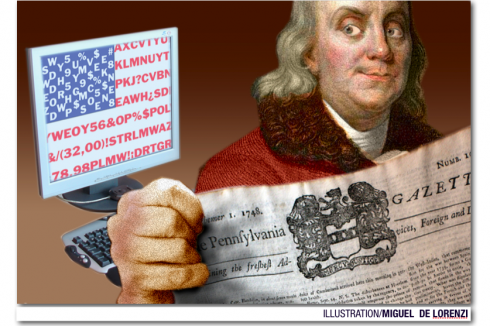
It is a lunch scene in rainy Hyderabad, India. One of the local editors with whom I am working ¬– who prefers to remain anonymous – has just returned from a tour of newspaper newsrooms in the United States.
“I am disappointed, to be honest,” the editor tells me. “I went to the U.S. to learn, to get ideas on how to improve our newspapers here, but in every case, I was faced with newspapers that are hardly innovative. In some areas, like advertising, we are actually ahead.”
WHAT THEY DO BEST:I tell the Indian editor that American newspapers do many things right. In fact, in some areas they are far better than anywhere else in the world. Take photojournalism for example. Few non-U.S. newspapers can compare to the quality and selection of photos in all sections. A large number of newspaper photographers in the U.S. have journalism degrees with majors in photojournalism, a rarity in the rest of the world. There is also local reporting, especially the treatment of human-interest stories, which is tops even in the smallest dailies in the nation. This is why I am disappointed that so many of our newspapers—especially medium and small metropolitan dailies—lag behind in the larger issues of story flow and advertising placement.
The editor asked me a question that I ask myself often:
“Why are American newspapers less willing to experiment, to take that leap into the future, to analyze their products and to adapt them to the realities of a multi-platform world?”
I have thoughts on the matter:
1. It is all about their mission: American newspaper editors, unlike their European and Asian counterparts, may have a heightened sense of mission. They see their role as that of producing the type of journalism that not only reports, but also exposes and investigates. It is the idea of the journalist as a missionary. I am a product of the journalism school, and I know that one emerges with a journalism degree and feels that part of the mission as a journalist is to protect and to save the world — or at least the microcosm of the world in which we function. As a result, editors are extremely protective of what they consider to be “serious journalism,” and with this comes a negative reaction to anything that, like innovative advertising, could create a notion of compromising ethical values. Not that it has to be, but editors react that way.
The same applies to any discussion of incorporating opinion pieces on news pages, away from the traditional editorial/op-ed pages. The list could go on.
I work with newspapers from around the world, and I find myself sometimes not even suggesting some ideas that have been successful for me in Europe or Asia, simply because I know the reaction will be negative and it is not worth the effort.
I find it puzzling that editors who know their newspapers need to be more playful with content to appeal to younger readers and need to offer more service, decide it is best to create a “new newspaper” instead of rethinking the newspaper they fail to change. This is a uniquely American phenomenon. When newspapers elsewhere decide to take a different course, they incorporate those changes in the existing newspaper (scroll down to sidebar :The Revolution Within). It does not occur to these editors to start a new title.

Examples that come to mind:
The Chicago Tribune’s Red Eye
The St. Petersburg Times’ tbt (Tampa Bay Times)
By the way, both the Red Eye and tbt are vibrant and visually strong products that hit their targets. I admire both, especially tbt, published in my city, Tampa. It is must read for me! But, why not incorporate these strategies in the main paper, instead of inventing a new one?
Could it be fear of alienating the older readers? Nonsense, I say. They will come along, a little upset at first, but they will not abandon you. It is attracting the new group of readers that matters most.
Rethinking of the existing newspaper makes more sense than creating a new one.
2. “We are newspaper people”: I also sense while visiting U.S. newsrooms that some American newspaper editors have a greater sense of the printed newspaper as king, with online and other digital editions being less important. It is not news until the “printed” newspaper publishes it, or so many working editors believe. The concept of the path of a story, and how it may travel from a simple alert, to a report, to a fully developed narrative, is not clearly defined in many newsrooms, leaving editors to make decisions based on their experience and background. Newspapers need to develop systematic approaches to how a breaking news event develops, using each medium to achieve its best potential rather than thinking that the printed newspaper is always the main medium. I would distribute buttons to everyone in the newsroom to remind them that they are NEWS people, NOT newspaper people.
This belief is more prevalent in U.S. newsrooms than anywhere else in the world.
One of the best editors with whom I have ever worked and who heads a large metropolitan U.S. newspaper, summarizes it like this:
“American journalists too often are absolutists or even fundamentalists. They regularly defend a form of top-down, tablets-from-the-mountaintop journalism. Any changes either to that approach or even to the surrounding content or the relationship with readers is seen as unacceptable compromise, which is silly. Change will come. You either drive it or are steamrolled by it.”
Another former editor whom I consulted for this piece, and who also prefers to remain anonymous, had this to say:
“While I’m no expert on international news media, I have the same sense that U.S. papers tend to lag behind those in some other countries (especially Europe, in my experience). One reason, I think, is that there are more national newspapers in, say, the UK and the historic competition has made them more nimble. Look at The Guardian.
“In the U.S., newspapers have been highly profitable local and regional monopolies that didn’t have to change — until suddenly the online and the economic scene shifted in the last several years. Now, U.S. newsrooms seem to be in a race between innovation (better storytelling and reader service on all platforms) and decimation (cuts that harm core functions and impair the future). I also have the impression that newsrooms have become much more innovation-oriented than ad and marketing departments. I guess that is a hopeful plus.”
3. What do you mean putting advertising there? : Nowhere is the lack of innovation more prevalent than in the treatment of advertising. While many newspapers seek innovative approaches to present advertising content, and to increase profits in the process, U.S. newspapers are slow to make progress in this area. It is only in the past two years that we have begun to see more ads on front pages. I know how reluctant editors are to that practice, although economic pressures have made them swallow hard and accept it. However, front-page ads are not the only way to innovate with ad placement. While some editors accept and seek new ways to present advertising, in the U.S. any suggestion of placing what I refer to as a“silent ad” between elements of a navigator, or sponsorship ads for the weather or TV listings, is seen as intruding into the landscape of the editorial integrity of the newspaper.
I strongly believe that it is in this area of advertising where a majority of U.S. dailies could adapt innovative ideas and turn the corner to attract new audiences and to improve revenue. It will take one or two leading newspapers to try it, and maybe the others will follow.
4. Let’s test it first: I believe there is an unhealthy dependency on constant focus groups and testing of ideas. Readers of this blog know that I am not against some use of focus groups. They can keep you from making an embarrassing mistake. However, I also believe that not every new idea has to be tested. Many times an innovative concept is shut down by readers who simply are not used to it, and therefore dismiss it as foreign to them. In my work globally, I definitely find that editors outside of the U.S. are more likely to let gut feeling, their nose, their eyes, or just a sense of street savvy, help them make decisions when it comes to introducing new concepts. They don’t rush to sit behind the mirror and let the events unfold, as the project collapses before their eyes.
ALL THE POSSIBILITIES ARE THERE FOR SUCCESS:
I believe U.S. newspapers could very quickly become leaders, change their fortunes and turn into models if editors would contemplate new ways of presenting information and advertising.
I also understand that the mood of journalists in the newsroom has a profound effect on the people who put out the product. I detect in the U.S, the gloom of economic forecasts is taking a toll on newsroom and corporate morale. This connects, by extension, to the willingness of a staff to innovate, or for an advertising staff to work diligently with the editorial team to go out and try to sell innovative ad positions. It is difficult for some advertising departments—which are scrambling to retain existing advertisers in traditional positions—to go out and try the radically new.
Unfortunately, both, the editors and the advertising department people, must make an effort to try new concepts.
If I were the publisher of a newspaper today, I would ban all pessimistic terms from the vocabulary of everyone working for me until further notice.

THE REVOLUTION WITHIN—
Five newspapers that changed, without inventing a new newspaper in the process.
The editors of these dailies realized that they had to make changes—-some more major and intricate than others. In each case, those changes were made INSIDE the existing newspaper. Yes, it took work, great effort and the pain which comes with abandoning comfort for the sake of progress. These newspapers had the ultimate garage sale, getting rid of the tired, unused and forgotten. They traded the dusty attic of the familiarly comfortable, for the risky, adventurous and fun. In each case, the newsroom leaders asked the “what if” question, and answered it themselves with a resounding “why not”.
Comfort is never a good station for innovation.
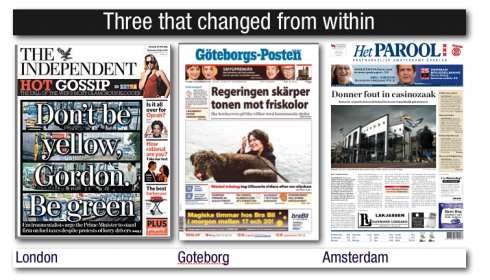
1. Goteborgs Posten (Sweden)—The editors of this daily, published in Sweden’s second largest city, knew that the landscape of their location was changing and the newspaper was not appealing to young readers as much. Such sections as Graffiti and Attityd were created. Others will be coming soon, as the GP is in a constant state of self analysis and irmprovement. Graffiti aims at the very young –pre-teens and up, while Attityd is for the young adults. Go www.gp.se, and www.attityd.nu
2. The Independent (London, UK)—This is one of the most radical rethinkings carried out by a newspaper. It is hard to find more surprising and interesting front pages –whether you agree with its philosophy or not. You will never find the headline of the day on this front page; but you will find the surprise of the day, which is more tempting and important. http://www.independent.co.uk/
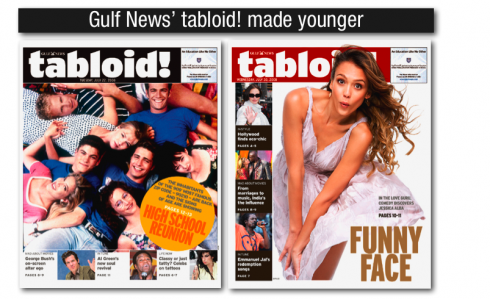
3. Gulf News (Dubai) –For years, this leading newspaper in the UAE, included a feature section called Tabloid which was nothing more than a bulletin board for events in the ever-growing metropolis. They could have called it boring. I remember the publisher/editor, Abdul Hamid, as chief architect of the rethinking of Tabloid: “Make it people oriented, put the gossip in, and bring in the celebrities from everywhere.” Presto. Big success, and the young readers can ‘t get enough of it. http://www.gulfnews.com/
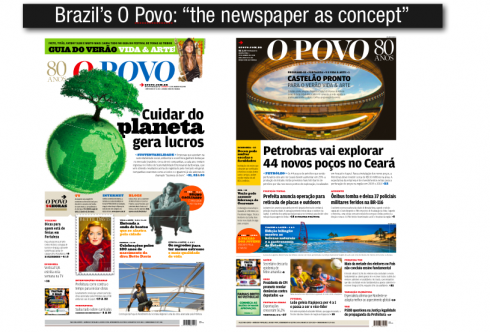
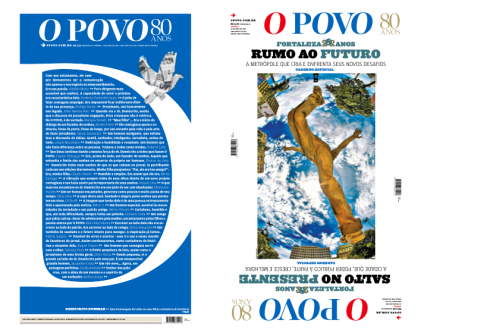
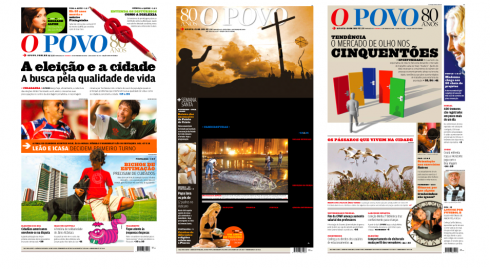
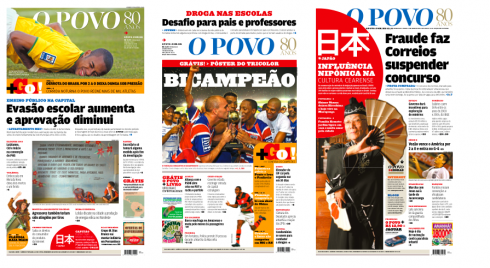
4. O Povo (Fortaleza, Brazil) –The editors knew that something had to change, that readers in this bustling city by the sea, were too busy to read a front page that was heavy with text. So, their new front page as a map to the inside of the newspaper was created. Big photos lead the way. There is no such thing as a lead story that everyone has heard about already; instead, headlines, images and short texts combine to provide an exciting window to what happened in the world that day. Says Rodrigo Fino, Garcia Media vice president and leader for this project: “At O Povo, evolution and innovation go hand in hand. O Povo is a concept more than a newspaper. In its efforts to truly link up with the community it serves, the editors are always looking at what they do and how they do it. We have worked with O Povo for 10 years, and their enthusiasm and self analysis is always as fresh as the first day. And it is important to note that in any changes here everyone participate: editorial, advertising, circulation, production. It is a very holistic approach to how the product is constantly evaluated. It works.”
http://www.opovo.com.br/
5. Het Parool (Amsterdam, Netherlands)—This was the little newspaper that could. In 2005, Het Parool, one of the Netherlands’ most respected dailies was ready to collapse and die. Many of the editors inside made it a point to save the newspaper. It took a total rethinking from change of format (huge broadsheet to tabloid), new editor, new vision (appeal to the young urban professional of Amsterdam. And a new focus: no more pretenses about being a national newspaper, and a total concentration of the excitement of Amsterdam. It worked. http://www.parool.nl/
These are only five examples. I am sure that there are many others that have revolutionized from within, including some U.S. dailies. I want to hear about them.
OF SPECIAL INTEREST: AT THE SUNDAY TIMES: THE COMPLETE MAKEOVER
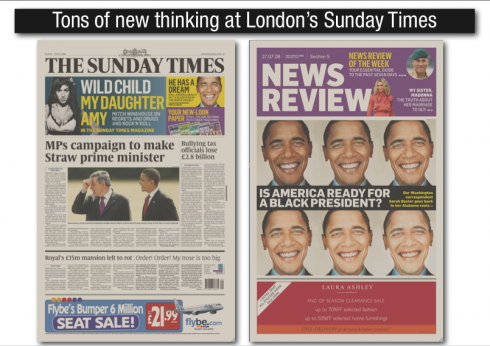
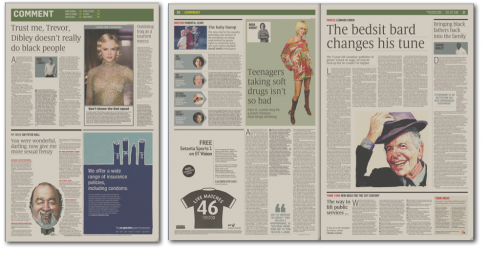
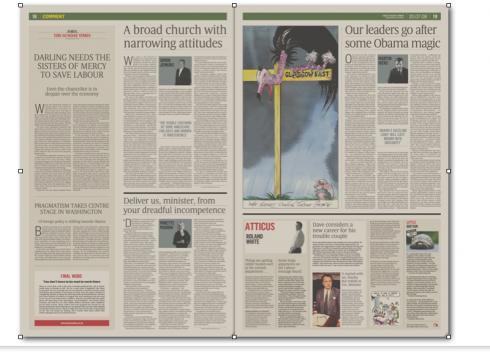
When the Sunday Times introduced its new product, July 6, it was obvious that this was more than just a change of typography, color and page architecture. The substantial changes were in the content. In the words of Editor, John Witherow:
“We have expanded the Comment section, introducing new features that present analysis in a fresh and, we hope, engaging way. Next to India Knight you will find the Briefing column in which an issue or story of the day is dissected from different perspectives. On the page opposite you will find Think Tank, in which writers can road-test new ideas for the 21st century”.
“The new Message Board feature opposite the expanded Letters page publishes the best of the issues readers can debate each week online”.
“The Little Britain column, a new addition to the Atticus diary on page 21
of Comment, invites you to send your observations about the joys and
irritations of modern life”.
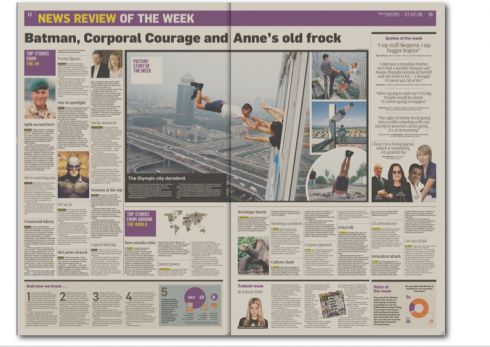
One of the biggest changes came in the News Review section – almost a mini newspaper now called News Review of The Week , a briefing of the entire week: Top stories from the UK, Top stories from around the World, TabloidWeek, And Now We Know…, Stats of the
Week, Quotes of the Week, Interviews of the Week, Talking Points (comments
in other papers during the week), Obituaries, Good Idea, Bad Idea, No Idea, Final Word and People of the Week.
These are the changes that make a difference.

Previous TheMarioBlog postings where related topics have been discussed.
The Sunday Times’ rethinking:
https://garciamedia.com/blog/articles/sunday_times_inside_pages_with_details/
https://garciamedia.com/blog/articles/al_trivino_interview_challenges_and_highlights_of_redesigning_the_sunday_ti/
Experimental advertising strategies:
https://www.garciamedia.com/blog/articles/lets_be_more_experimental_with_advertising/
Focus groups:
https://garciamedia.com/blog/articles/focus_groups_to_test_or_not_to_test_or_is_it_what_to_test/
The path of the story:
https://garciamedia.com/blog/articles/the_path_of_the_story_from_mobile_to_online_to_print/
‘

At the June 2008 WAN (World Association of Newspapers) conference in Goteborg, Sweden, the following circulation facts were presented:
*Global newspaper sales were up +2.57 percent over the year, and had increased +9.39 percent over the past five years.
*In the European Union, paid daily newspapers saw a -2.37 percent drop in 2007 and a -5.91 percent drop since 2003. Combined with free dailies, circulation in the EU rose +2 percent over one year and +9.61 percent over five years.
* The circulation of U.S. dailies fell -3.03 percent in 2007 and -8.05 percent over five years. Most of the decline came in evening dailies, which saw a year-on-year circulation decline of -10.08 percent, compared with only -1.97 percent for morning dailies. Over the past five years, evening dailies declined -25 percent, compared with a -5.08 percent drop for morning newspapers.
Where the big circulation gains are:
Latin America, Asia and the Middle East.
For complete report go: http://www.futureofthenewspaper.com/

http://www.futureofthenewspaper.com/
http://redeye.chicagotribune.com/
http://tampabay.com/tbt/
The Nation’s: section fronts

In Hyderabad, India, putting finishing touches on new changes to Sakshi, the brand new but already very successful daily here. With 1.2 million circulation, it continues to grow. Yes, a newspaper that premiered March 23, 2008, is already holding its first “garage sale”, and seeking new ways.
See my Friday blog posting for details of this incredible success story.